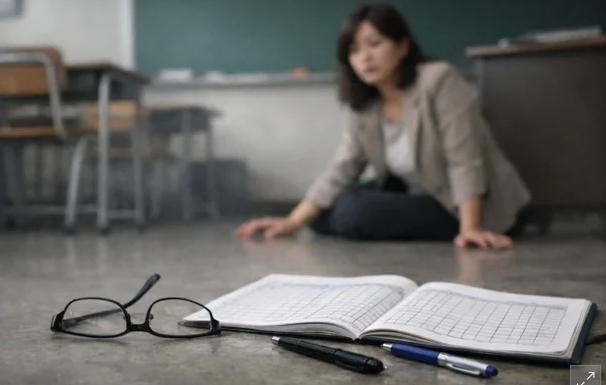
After news broke that a female teacher at a middle school in Gwangju, Gyeonggi Province was assaulted by a student and taken to the emergency room, public opinion was intense, with calls for strict punishment saying "records must be kept" and calls for "public education, which has neglected the collapse of teachers' authority," to take responsibility. According to the Korean Federation of Teachers' Associations, at the end of last month, a male student assaulted a female teacher during physical education class at a middle school in Gwangju, Gyeonggi Province, and the victim suffered injuries requiring two weeks of recovery. She received emergency room treatment, and the case has been filed with the Regional Teachers' Rights Protection Committee and is awaiting review. The KFTA directly pointed out the issue of 'record gaps,' stating that while measures against school violence between students remain in the student record, even if a teacher is assaulted , transfers or expulsions are not recorded in the student record. The KFTA argued that this structure could send a wrong signal that serious violations of teachers' rights are taken lightly, and called for legal measures including recording in student records. In the comment section, responses continued: "Teacher assaults should be recorded like school violence," "Expulsion and disadvantages for admission should follow," and "There is no minimum measure to protect the victim teacher." Even a serious case like this is being recorded in the student record. There are concerns that if it does not remain, the distorted perception that "teachers can be hit is allowed" will only be cultivated on the ground. On the other hand, many pointed out that this incident cannot be seen solely as a misconduct by a specific student, with comments such as, "Classroom We need to first look at the structure where control has collapsed," "Isn't this the result of the balance between student rights and teachers' rights being tilted to one side?", and "The education authorities have left the field unattended for too long." Strengthening punishment alone They argue that similar incidents are difficult to prevent and ultimately require a complete overhaul of the public education system. This view views both the weakening of protective mechanisms for teachers and the retreat of on-site leadership as problems, arguing that the burden of parent complaints and the gap between systems and the field make it difficult for teachers to protect students' right to learn in unsafe classrooms. They say it's not just about raising the level of disciplinary action, but about rebuilding the collapsed classroom operation system itself.
Comments 0
Log in to comment.