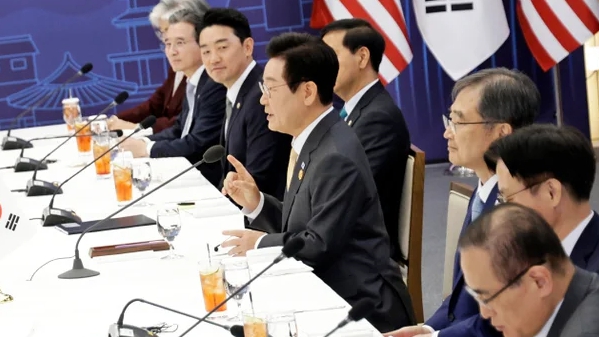
The 'installment investment' method was unprecedented in Japan or the EU, and the US had until recently demanded that the entire $350 billion be invested in advance payments, so it was a mystery how they accepted the 'installment investment' approach. As is well known, Trump had demanded 'full cash advance' until just a month ago, and President Lee Jae-myung was visiting New York to attend the UN General Assembly at the time, where he met Treasury Secretary Scott Besant and directly explained that the US was making demands we simply could not handle. At the same time, our government formalized discussions on a 'currency swap,' and it is understood that the US repeatedly demanded it despite knowing it would be difficult to accept the 'currency swap' demand. A key government official said, " No matter how many times we explain that $350 billion in advance is impossible, it doesn't work, so we have strongly requested a currency swap that the U.S. finds difficult to accept." They have arranged a situation where both sides have no choice but to make concessions so that both sides can each withdraw their demands for full prepayment and currency swaps that they cannot handle. After both sides stepped back, discussions progressed to determine how much investment our foreign exchange market can handle annually, and ultimately decided on a maximum annual investment of $20 billion It is said that the negotiations were concluded through a 'split investment' called 'investment.' Initially, the U.S. demanded 25 billion won, while South Korea pushed for 15 billion won, but eventually, the U.S. stepped back with 20 billion won, dramatically settling the deal!!!!!!
Comments 0
Log in to comment.